---
title: p.book.category
description: "## Syntax **p.book.category** ## Purpose The p.book.category annotation is used to tag an element as being part of a group of related books within a book’s metadata. This annotation creates a marker used by search tools to establish relevance…"
url: "https://www.stilo.com/docs/migrate/book/p-book-category/"
updated: "2023-12-04"
category: Annotations / Book, Map and Bookmap
tags:
- Annotations
---
# p.book.category
## Syntax
**p.book.category**
## Purpose
The p.book.category annotation is used to tag an element as being part of a group of related books within a book’s metadata. This annotation creates a marker used by search tools to establish relevance to a subject. Multiple categories may be assigned to a book. This annotation applies a tag which adds the element to the DITA bookmap’s metadata.
## Examples
The following is an example of a time where you might want to use the p.book.category annotation:
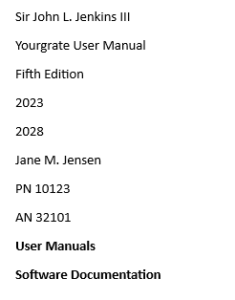
*Note: the relevant paragraph has been marked in bold for this example. The paragraph is not bold in the source document.*
The following is an example of a rule that will apply p.book.category :

The following is the DITA XML output for the previous rule (relevant portion in bold):
User Manuals
Software Documentation
````