---
title: conref(), conkeyref() annotations
description: "## Syntax **conref**((**key**=keyname)(**id-for-the-library**=libraryid)(**filename**=filename)(**content**=texttoconref)(**topic-type**=type)) key short label used to identify the text being referenced id-for-the-library (optional) the file ID for your conref file filename (optional) name for your file; this file will be included in your DITA output content (optional) the…"
url: "https://www.stilo.com/docs/migrate/linking-referencing-and-keywords/conref-conkeyref-annotations/"
updated: "2021-04-29"
category: Annotations / Linking, Referencing and Keywords
tags:
- Annotations
---
# conref(), conkeyref() annotations
## Syntax
**conref**((**key**=keyname)(**id-for-the-library**=libraryid)(**filename**=filename)(**content**=texttoconref)(**topic-type**=type))
key
short label used to identify the text being referenced
id-for-the-library (optional)
the file ID for your conref file
filename (optional)
name for your file; this file will be included in your DITA output
content (optional)
the text that will replace the conref in the published document
topic-type (optional)
type of topic for your library file
**conkeyref**((**key**=keyname)(**id-for-the-library**=libraryid)(**filename**=filename)(**content**=texttoconkeyref)(**topic**-type=type))
key
short label used to identify the text being referenced
id-for-the-library (optional)
the file ID for your conkeyref file
filename (optional)
name for your file; this file will be included in your DITA output
content (optional)
the text that will replace the conkeyref in the published document
topic-type (optional)
type of topic for your library file
If you use the argument topic-type, you must also use the argument id-for-the-library in your annotation.
## Purpose
These commands operate in a similar way; they allow you to easily reuse content. The difference between a conref and a conkeyref is in how the content being brought into your document is referenced, or located.
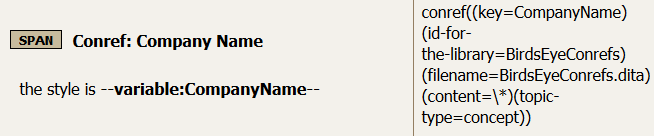
A conref requires a URI-based, or direct, reference to the content being pulled in. (For more information on URI-based addressing, please see the DITA specification for [URI-based addressing](http://docs.oasis-open.org/dita/v1.2/os/spec/archSpec/uri-based-addressing.html#uri-based-addressing).) For example, using a conref to replace the variable CompanyName with the company name Birds Eye Inc would give you a rule that looks like this:
[](https://www.stilo.com/wp-content/uploads/2021/03/conref-rule.png)
You will get output in your topic that may look like the following:
```
Words and logos marked with ® or ™ are registered trademarks or
trademarks owned by
Birds Eye Inc
.
Other brands and names mentioned herein may be the trademarks of
their respective owners.
```
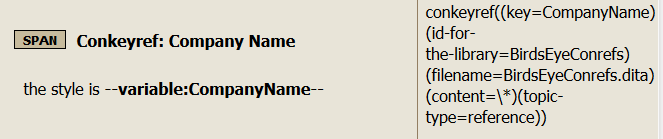
A conkeyref uses an indirect method to access the content being pulled in. Using a conkeyref to replace the variable CompanyName with the company name *Birds Eye Inc* would give you a rule that looks like this:
[](https://www.stilo.com/wp-content/uploads/2021/03/conkeyref-rule.png)
This may give you the following output in your topic:
```
Words and logos marked with ® or ™ are registered trademarks or
trademarks owned by
Birds Eye Inc
.
Other brands and names mentioned herein may be the trademarks of
their respective owners.
```