---
title: "p.title.for-following-content"
description: "## Syntax **p.title.for-following-content** ## Purpose The p.title.for-following-content annotation tags a paragraph as a title for the content that comes immediately after it. The following content can be any format that is not a new topic (e.g. text, image, link). ##…"
url: "https://www.stilo.com/docs/migrate/prolog/p-title-for-following-content-3/"
updated: "2023-11-03"
category: Annotations / Prolog
tags:
- Annotations
---
# p.title.for-following-content
## Syntax
**p.title.for-following-content**
## Purpose
The p.title.for-following-content annotation tags a paragraph as a title for the content that comes immediately after it. The following content can be any format that is not a new topic (e.g. text, image, link).
## Examples
The following is an example of a time when you might want to use the p.title-for-following-content annotation:
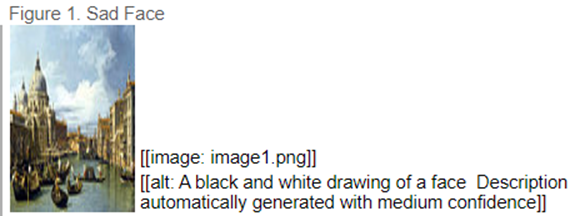
The following is an example of a rule that will apply p.title.for-following-content:

The following is an example of the DITA output you would get from this annotation.
`Figure 1. Sad Face
A black and white drawing of a face Description automatically generated with medium confidence
```