---
title: "s.index-see-also"
description: "## Syntax **s.index-see-also** ## Purpose The s.index-see-also annotation is used to tag a span element as being a phrase in an index referring a user to another entry for additional information. In an index, *See also* is used to refer…"
url: "https://www.stilo.com/docs/migrate/task/s-index-see-also/"
updated: "2023-12-11"
category: Annotations / Task
tags:
- Annotations
---
# s.index-see-also
## Syntax
**s.index-see-also**
## Purpose
The s.index-see-also annotation is used to tag a span element as being a phrase in an index referring a user to another entry for additional information. In an index, *See also* is used to refer the reader to a related entry to give greater context or more complete information. This is generally done for terms that are not interchangeable but are connected in some manner (e.g. dolphins, *See also: whales*).
## Example
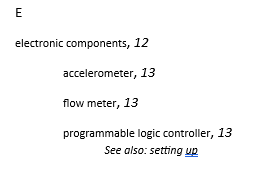
The following is an example of a time where you might want to use the s.index-see-also annotation:
The following is an example of a rule that will apply s.index-see-also:

The following is the DITA XML output for the previous rule:
E
electronic components, 12
accelerometer, 13
flow meter, 13
programmable logic controller, 13
See also: setting up