---
title: s.option
description: "## Syntax **s.option** ## Purpose The s.option annotation is used to tag a span element as being an optional argument in a function, API, command, or any other programming element that takes arguments. ## Example The following is an example…"
url: "https://www.stilo.com/docs/migrate/task/s-option/"
updated: "2023-12-11"
category: Annotations / Task
tags:
- Annotations
---
# s.option
## Syntax
**s.option**
## Purpose
The s.option annotation is used to tag a span element as being an optional argument in a function, API, command, or any other programming element that takes arguments.
## Example
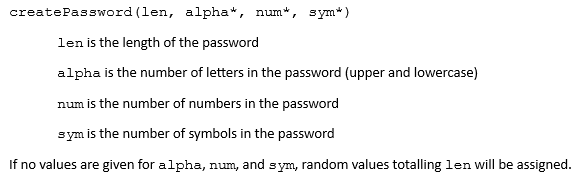
The following is an example of a time when you might want to use the annotation
The following is an example of a rule that will apply the annotation

The following is the DITA XML output for the rule:
len is the length of the password
is the number of letters in the password (upper and lowercase)
is the number of numbers in the password
is the number of symbols in the password
If no values are given for , , and , random values totalling len will be assigned.